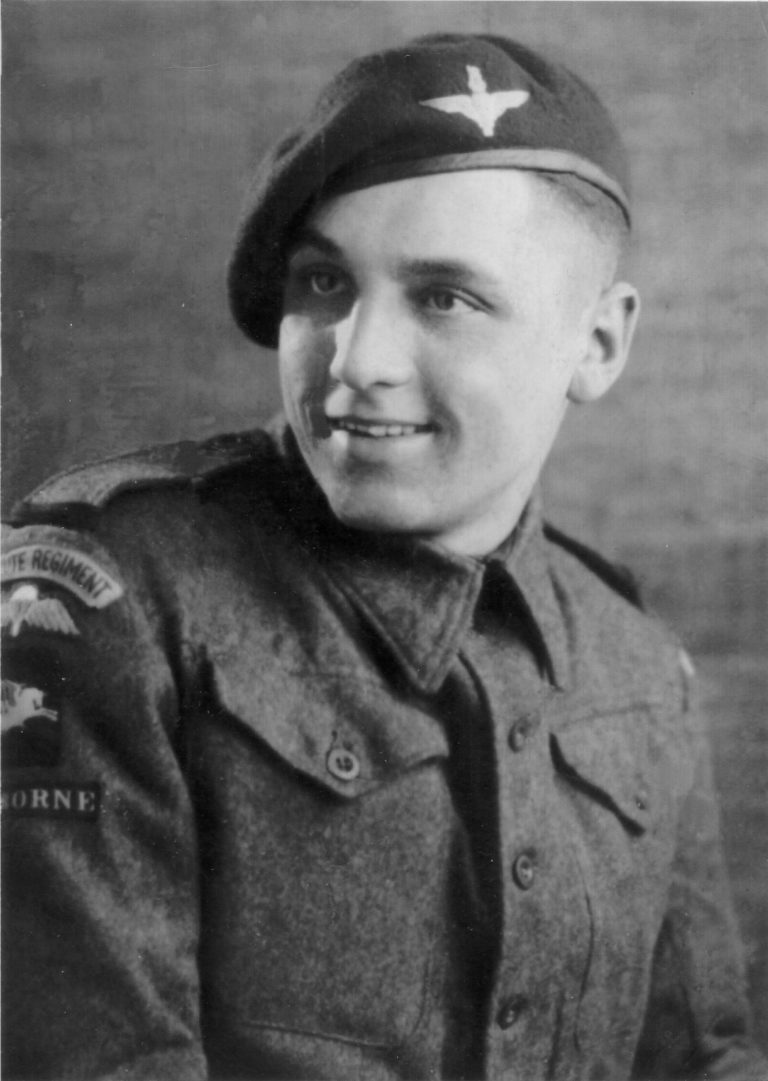
Christopher Jack Walton. 9th Parachute Battalion.
Service No: 14614464
Christopher Jack Walton was born in Kentish Town, London on 25th December 1924. He was the youngest of three ‘Walton Boys’ that were called to serve their country.
The eldest Nathan, was a member of the Territorial Army (Army Reserve) and joined the Royal Artillery at the outbreak of war in 1939. He survived the wounds that he received at Dunkirk, only to die on active service in 1942.
Next was Robert, also a member of the Territorial Army, joining the Royal Artillery in 1939. He served with the 64th Medium (London) Regiment in North Africa, where he received life-changing injuries as a result of a German air assault whilst towing the gun in his charge.
Desperate to follow in the footsteps of his brothers, Christopher first joined The 5th Battalion, County of London Home Guard at the age of 17 and served from May 1941 until May 1943. He was subsequently called for war service with the Royal Fusiliers on May 20 1943.
He undertook his basic training at Brentwood in Essex and on completion, sought selection for the Parachute Regiment at Bury St Edmunds in Suffolk. He passed selection process and was invited to join the regiment.
He undertook training at Hardwick Hall in Derbyshire and completed his parachute training on course number 87 at Ringway, Manchester. After a satisfactory completion, he was posted to the 9th Battalion The Parachute Regiment in late October 1943.
He was initially posted to ‘A’ Company but was subsequently transferred to the machine gun section, where he was the number two, to Corporal Harry Lockett on a Vickers Machine Gun.
Christopher was part of the assault on the Battery at Merville on the 6th June 1944. In July 1944, he received a mortar wound to his leg and was briefly repatriated home for treatment and returned to his unit within a two-week period. He participated in the action at the River Seine in August and was also involved in operations at Breville, Dozule, Pont L’Eveque and Beuzeville. He returned to the UK with the Battalion in September 1944.
He was granted permission to marry on December 3rd 1944 but within a few days of his leave, was called back to the Battalion to prepare for action in the Ardennes during the winter of 1944-1945.
After action in the Ardennes, he moved to Horn in Holland where the machine gun section set up a position near to Roermond by the River Meuse.